

Every vendor has an AI story right now. But for SMBs and mid-market IT teams, the question isn't whether to adopt AI – it's where it will actually move the needle, and where it's likely to create more noise than value.
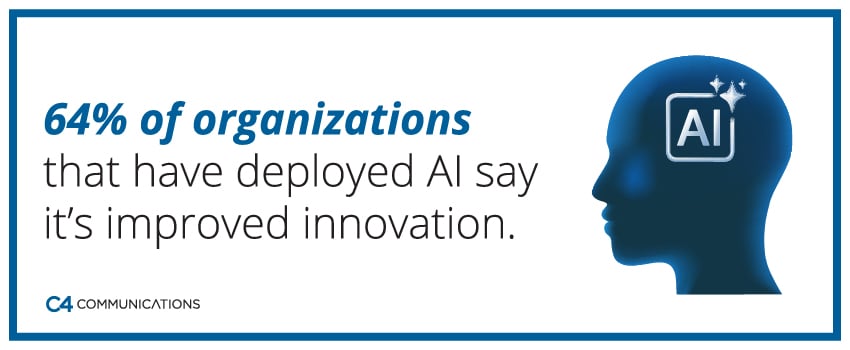
According to McKinsey's The State of AI in 2025 report, 64% of organizations that have deployed AI say it’s improved innovation, but only 36% have reported increased profitability.1 What’s the disconnect? Successful deployments must start with a clear strategy and proper implementation.
Here's an honest look at what's working, what's not, and how to cut through the hype.
Where AI in Business IT Is Delivering Real ROI
Not all AI is created equal. In telecom and cloud environments, a handful of use cases have proven their value in real-world deployments – not just in vendor benchmarks.
AI-Powered Call Routing
Intelligent call routing is one of the clearest wins we’ve seen so far. AI contact center platforms can analyze caller intent, history, and agent availability in real time to connect customers faster and more accurately than non-AI options. As a result, contact centers are seeing shorter handle times, fewer transfers, and higher first-call resolution rates.
Automated IT Support Workflows
For internal IT teams, AI-assisted ticketing tools can triage, categorize, and route support requests without manual intervention. When integrated with your UCaaS or helpdesk platform, these tools reduce the administrative load on IT staff and speed up resolution times – a meaningful efficiency gain for lean teams.
Fraud Detection and Cybersecurity
AI has become an integral layer in modern cybersecurity solutions. Behavioral analytics and anomaly detection tools can identify suspicious activity across your network faster than any human monitoring process. For businesses handling sensitive data, this is one area where AI investment consistently justifies itself.
Where Artificial Intelligence for Communication Is Overhyped
Alongside the wins, there's a fair amount of AI functionality that doesn't deliver at the SMB level yet – either because the underlying technology isn't mature, the implementation cost is too high, or the business case simply isn't there.
Watch out for these common over-promises:
- AI "assistants" that require significant training data. Small and mid-market businesses often don't have the call volume or structured data to make these tools effective out of the box.
- Fully autonomous customer service bots. Chatbots and virtual agents handle routine inquiries well, but complex or emotionally charged interactions still require a human. Businesses that over-automate often see customer satisfaction scores suffer.
- Predictive analytics dashboards with no clear action path. Generating insights is only valuable if your team has the bandwidth and processes to act on them. Many AI analytics tools produce data that sits unused.
- AI features bundled into platforms you're already paying for. Vendors are adding "AI" to existing feature sets and repricing accordingly. Before paying more for an upgraded tier, confirm the specific features you'll actually use.
The pattern across all these overhyped cases is the same: the technology works, but not in the way vendors typically promise.
4 Questions To Ask When Evaluating AI Solutions
Before adding any AI tool to your stack, run it through these four questions:
1. What Problem Does This Solve?
If the answer is vague, that's a red flag. You should be able to describe the specific workflow or challenge you're solving in one or two sentences. If the vendor can't explain that clearly, the solution probably isn't right for you.
2. Can We Measure the Outcome?
Identify the metric you expect to improve – such as call resolution time, ticket volume, or fraud incidents – and confirm that the vendor can provide baseline benchmarks. Without measuring the outcomes, you have no way to know if your investment paid off.
3. What Does Implementation Require?
The real cost of AI is usually in the setup, not the subscription. Factor in data preparation, staff training, and system integrations upfront so you can budget time and money more accurately without deployment taking longer than expected.
4. Does It Fit Where We’re Headed?
Any tech tool that works for your business today should still make sense 18 months from now as you add staff, expand services, or shift priorities. Avoid the ones that lock you into a specific vendor or create technical debt that's hard to escape later.
Ready for Realistic AI Adoption? C4 Can Guide You
AI is a powerful tool when applied well. The businesses getting the most from it right now aren't those chasing every new announcement. They're the ones making deliberate decisions grounded in clear business outcomes.
At C4, we hear from a lot of businesses that have been burned by AI tools that looked great in a demo and underdelivered in practice. As an independent technology solutions consultant, our role is to help you evaluate AI solutions based on your specific goals – not a vendor's quota.
Whether you're exploring AI features within your current UCaaS platform, considering an AI-enhanced contact center upgrade, or trying to determine whether your cybersecurity stack is keeping pace, our solution consultants can help you separate what's worth investing in from what's worth waiting on.
Ready to think through what AI adoption should look like for your business? Talk to our team – we'll help you build a strategy that makes sense for where you are today and where you're going.
Sources: